Infrastructure & Capital Planning
Facilities, apparatus, and equipment needed to meet current and future service demands.
Read the full sectionBulverde Spring Branch Emergency Services
A 10-year plan to protect life, property, and community well-being across western Comal County. Explore it visually, or read the full official document line by line.
Adopted June 2026
This page is just here to help you find your way around. It doesn’t change or replace any part of the official plan.
There are two ways to get around, and you can switch anytime. Want the quick tour? Just scroll and you’ll get the mission and values, the six Strategic Pillars as cards, and the timeline. Want the real document? Use the menu (on the left on a computer, or the ☰ button on your phone) or the buttons below to jump to any section and read it word for word. And anywhere you see a summary, there’s a “Read the full section” link that takes you to the official wording.
Pick a section and you’ll jump straight to its full official text.
Prefer the original file? You can download the board-approved PDF anytime from the button in the top bar. Your browser’s print option also makes a clean copy of the full text.
Every word below is quoted straight from the plan: the “Plan Overview” on page 6 and Section 2 on page 12.
To safeguard life, protect property, and promote public safety with the highest level of professionalism.
To identify, serve, and champion the needs of others.
Integrity • Compassion • Accountability • Respect • Empathy
These six pillars guide every decision, dollar, and project in the plan. Each card links to its full official text in Section 8.
Facilities, apparatus, and equipment needed to meet current and future service demands.
Read the full sectionA skilled, adequately staffed, future-ready workforce with strong leadership and succession pathways.
Read the full sectionDeployment, training, equipment, and practices that keep response efficient and effective.
Read the full sectionEducation, mitigation, outreach, and community health that prevent emergencies before they occur.
Read the full sectionDigital tools and infrastructure for efficient operations and informed decisions.
Read the full sectionCoordination with ESDs, local governments, and regional partners for unified service delivery.
Read the full sectionThe plan rolls out in three phases. You’ll find the full details in Section 10, and the phase names and years below come straight from the plan (pages 4 and 6).
Stabilize operations, make foundational technology and facility investments, establish KPIs, and launch leadership development.
Read Phase I in fullOpen and staff new stations, execute major fleet replacements, expand training capacity, and grow regional partnerships.
Read Phase II in fullOptimize the system using performance data, complete technology modernization, and prepare for the next long-range plan.
Read Phase III in fullStart typing to filter the list, then click any result to jump to the full official text. It’s the same Table of Contents you’ll find on pages 7–9 of the plan.
No sections match your search. Try a different word.
The opening messages from BSBES leadership, word for word from the plan.
The 2027-2037 Strategic Plan represents an important milestone for Bulverde Spring Branch Emergency Services (BSBES). It reflects the collective insight, expertise, and commitment of our Board, leadership team, and employees. Developed through a collaborative planning effort, this document establishes a long-term framework to guide organizational priorities, support informed decision-making, and prepare BSBES to meet the evolving needs of the communities we serve.
The development of this plan began with extensive input from Operations, Training, Human Resources, Logistics, Finance, Community Risk Reduction, and Administration. Departments provided detailed assessments of current capabilities, operational challenges, workforce needs, capital requirements, and long-range considerations. Those contributions were reviewed and integrated through the Strategic Plan Working Group, co-chaired by the Fire Chief and General Manager, with participation from representatives of the participating Emergency Services Districts and organizational leadership.
This Strategic Plan recognizes that the next decade will bring continued development, evolving service demands, changing community risks, and increasing expectations for emergency services. To remain effective, BSBES must continue planning deliberately, investing responsibly, and maintaining the flexibility necessary to adapt to future challenges and opportunities.
The six Strategic Pillars identified in this plan—Infrastructure & Capital Planning, Staffing, Workforce & Leadership Development, Operational Readiness & Response Performance, Community Risk Reduction & Public Safety Engagement, Technology, Data & Communications Systems, and Interagency Coordination & Regional Partnerships—provide a framework for aligning resources, priorities, and decision-making over the next ten years.
The strength of BSBES lies in its people. This plan honors their expertise, dedication, and commitment to service by establishing a path that supports operational readiness, professional development, safety, and long-term organizational resilience. Its successful implementation will depend upon continued collaboration among our Board of Directors, participating Emergency Services Districts, employees, community leaders, and regional public safety partners.
We are grateful for the contributions of everyone who participated in this process and for the shared commitment to building a strong and sustainable future for BSBES. Together, we will continue strengthening our organization and ensuring we remain prepared to protect the lives, property, and well-being of the Bulverde and Spring Branch communities for years to come.
James Shadle, General Manager
Mark Southwell, Fire Chief
Co-Chairs, Strategic Plan Working Group
Bulverde Spring Branch Emergency Services
On behalf of the Board of Directors, I am pleased to introduce the Bulverde Spring Branch Emergency Services (BSBES) 2027-2037 Strategic Plan. This plan represents a significant and forward-looking commitment to the communities of Bulverde and Spring Branch, a commitment to ensuring that our emergency services remain strong, resilient, and capable of meeting the region’s growing needs over the next decade.
The Board is grateful for the collaborative effort that shaped this plan. Each department within BSBES contributed meaningful insight into current challenges, operational realities, staffing requirements, capital needs, and long-term priorities. The Strategic Plan Working Group, co-chaired by the General Manager and Fire Chief, worked diligently throughout 2026 to refine and align the Strategic Plan for Board consideration.
As our region continues to grow, the Board recognizes the importance of proactive planning. This 10-year framework outlines the strategic direction that will guide investment decisions, budget priorities, facility expansion, workforce development, and operational readiness. It reaffirms our commitment to providing high-quality fire and EMS service, enhancing public safety, and strengthening community resilience.
We deeply appreciate the dedication of the men and women who serve within BSBES. Their professionalism and hard work embody the mission of this organization, and this plan is designed to support them, now and into the future. We also thank our partner Emergency Services Districts and community stakeholders for their continued collaboration and support.
The Board looks forward to working with the organization as this plan moves from concept to practice, ensuring that BSBES remains well-prepared to meet the demands of the coming decade. Together, we will continue building an emergency services system our community can rely on with confidence.
Deborah Kruciak, Board Chair Bulverde Spring Branch Emergency Services
Here’s the gist. The area BSBES covers is growing fast, so this plan spells out how the organization will keep up over the next ten years without overspending. It’s built around six priorities (the “Strategic Pillars”) and happens in three phases. One thing worth knowing: the plan points the direction, but the money still gets approved year by year by the Board. The official summary is right below.
Bulverde Spring Branch Emergency Services (BSBES) operates in a region experiencing sustained residential and commercial development, resulting in increased demand for emergency services. Continued residential and commercial development is expected to increase emergency service demand, expand community risk, and place greater pressure on response systems over the coming decade.
The 2027-2037 Strategic Plan provides a long-term framework to help the organization prepare for this growth in a deliberate, financially responsible manner. Developed through departmental analysis, employee input, regional planning considerations, and Board priorities, the plan establishes shared direction and a structured approach for decision-making.
The plan is organized around six Strategic Pillars that guide organizational priorities and resource planning:
Over the next ten years, BSBES may require additional stations, expanded staffing, enhanced training capacity, modernized technology, predictable fleet lifecycle management, and strengthened regional coordination. The plan also recognizes key financial constraints, including revenue limitations, rising operating costs, and the need to align all investments with long-term fiscal capacity.
To ensure responsible implementation, the Strategic Plan uses a phased roadmap:
The Strategic Plan establishes a 10-year planning horizon; however, operational and financial commitments will be made only through the annual budget process and ongoing Board review. Future phases represent planning direction rather than pre-authorized expenditures and may be adjusted based on financial performance, growth patterns, and Board priorities.
This approach provides long-term visibility without limiting governance flexibility.
Through disciplined implementation, annual evaluation, and continued collaboration with participating ESDs and regional partners, BSBES will remain positioned to protect life, property, and community well-being while managing growth in a fiscally responsible manner.
This Strategic Plan is organized to provide a clear understanding of where BSBES is today, where the organization needs to be over the next decade, and how it can navigate that path. Each section builds upon the previous one to guide the reader from foundational context to long-range priorities and implementation.
To safeguard life, protect property, and promote public safety with the highest level of professionalism.
To identify, serve, and champion the needs of others.
Integrity • Compassion • Accountability • Respect • Empathy
These six pillars define the long-term priorities that will guide all decisions, investments, and initiatives.
Phase I: Foundation & Stabilization (2027-2029)
Phase II: Expansion & Integration (2030-2033)
Phase III: Optimization & Sustainability (2034-2037)
10 Years - 2027 through 2037
To guide the development of the 2027-2037 Strategic Plan, BSBES followed a structured and collaborative planning process. The plan integrates organizational data, stakeholder input, operational needs, and future growth projections to create a unified direction for the next ten years.
Five key departments contributed formal submissions to the strategic plan:
These departments represent the core functional areas that shape service delivery, workforce capability, and long-term sustainability.
Each department provided input on:
All departmental inputs were aligned under the six Strategic Pillars identified in Section 8.
Administrative leadership reviewed department submissions and:
The Strategic Plan was assembled through:
This methodology ensures the strategic plan is data-informed, department-driven, financially grounded, and aligned with the long-term needs of the community.
The BSBES Strategic Plan is designed as a long-range framework guiding organizational decisions from 2027 through 2037. Because the 2026 budget has already been approved, this plan will not influence operational or financial commitments in 2026.
The Strategic Plan Working Group met from January through May 2026 to:
The Strategic Plan is being presented to the BSBES Board for consideration and adoption in June 2026.
This structure allows BSBES to embed long-term priorities, capital planning, staffing models, and operational initiatives into the annual budgeting cycle beginning with FY27.
This part introduces who BSBES is and the world it works in. You’ll find the mission, vision, and five core values (ICARE), how the Emergency Services Districts (ESDs) oversee it all, the growth coming over the next ten years, the assumptions behind the plan, and the risks it has to plan around. The full official text is just below.
To safeguard life, protect property, and promote public safety with the highest level of professionalism.
To identify, serve, and champion the needs of others.
The core values of Bulverde Spring Branch Emergency Services guide our actions, shape our culture, and define how we serve the community. Together, we live the ICARE standard:
We do the right thing - honestly, ethically, and with accountability in every action.
We treat every person with dignity and empathy, recognizing the human side of every call and every interaction.
We take ownership of our decisions, our performance, and the responsible stewardship of public trust and resources.
We value one another, our profession, and the community we serve by demonstrating professionalism, care for our people and resources, and pride in the trust placed in us.
We strive to understand the perspectives and needs of others. By listening, caring, and treating people with dignity, we build trust and strengthen the relationships that are essential to serving our community.
Bulverde Spring Branch Emergency Services (BSBES) provides fire and EMS protection to a 216-square-mile district in western Comal County. The organization operates 24/7 with a workforce of over 100 personnel including firefighters, EMTs, paramedics, engineers, officers, and administrative staff. BSBES responds to thousands of calls annually and continues to evolve with ongoing development and increasing service demand across the region.
Bulverde Spring Branch Emergency Services (BSBES) operates under the governance and fiscal authority of its participating Emergency Services Districts (ESD 1, ESD 4, and ESD 5), each of which is an independent governmental entity governed by its own Board of Commissioners. These ESD Boards collectively provide policy direction, funding authorization, and strategic oversight for the delivery of fire, EMS, and prevention services within their respective jurisdictions.
BSBES functions as a nonprofit organization to administer and deliver services on behalf of the participating ESDs. Its Board of Directors, composed of representatives from each ESD and one at-large director, serves as the governing body responsible for implementing ESD-established priorities, approving organizational policy, and exercising fiduciary oversight.
Governance, financial stewardship, and long-term sustainability underpin every Strategic Pillar in this plan. All initiatives are evaluated through the lens of ESD authority, fiscal responsibility, and phased implementation to ensure long-term organizational stability.
The General Manager and Fire Chief are responsible for executing Board-directed strategy, managing daily operations, and ensuring organizational performance aligns with Board policy, budget authority, and long-term objectives.
This governance structure ensures clear accountability, preserves ESD authority, and enables coordinated service delivery across district boundaries through a unified operational model.
Bulverde Spring Branch Emergency Services operates in a region that has sustained residential and commercial development in recent decades. Over the next decade, sustained residential development, expanding commercial corridors, and increased mobility throughout the region will significantly influence both fire and EMS service demand. To remain effective, BSBES must anticipate these trends and plan proactively rather than respond reactively. This long-range planning context outlines the demographic, operational, and environmental factors shaping the organization’s future needs and strategic direction.
Current development patterns and regional planning activity indicate continued population growth between 2027 and 2037, with the greatest concentration along U.S. 281 and Highway 46. As development and density increase, call volume for fire, EMS, and community risk reduction services will rise accordingly. Meeting this demand will require additional stations, expanded staffing, and optimized deployment models to maintain reliable response performance and reduce service gaps.
The current station footprint may not be sufficient to meet expected service needs over the next decade. Long-term planning identifies the need for new stations, targeted renovation of existing facilities, and modernization of infrastructure to support contemporary operational requirements. These capital needs must be phased strategically to align with growth patterns, financial capacity, and staffing availability.
A 10-year planning horizon allows BSBES to systematically manage lifecycle replacements for engines, ambulances, specialty units, and mission-critical equipment. Predictable replacement schedules reduce operational downtime, strengthen fleet reliability, and stabilize long-term budgeting. Additionally, community growth may increase the need for specialized equipment to support wildland response, technical rescue, water operations, and other high-risk incident types.
Long-range planning must account not only for frontline response needs, but also for the infrastructure and support systems required to sustain daily operations. Over the next decade, BSBES will face increasing pressure on fleet maintenance, logistics operations, information technology, and facilities management as apparatus counts grow, stations expand, and service demand increases.
Detailed assessments indicate that several existing fire and EMS facilities are at or near functional capacity, limiting opportunities for future expansion without significant renovation or replacement. Aging infrastructure, constrained bay space, and deferred facility upgrades present long-term operational and efficiency challenges.
Fleet lifecycle planning further demonstrates the importance of predictable capital investment. A significant portion of the apparatus fleet will require major rehabilitation, remounting, or replacement within the 2027-2037 planning horizon. Without structured replacement cycles and adequate maintenance capacity, operational readiness and reliability may be impacted.
These factors underscore the need for integrated capital planning that aligns facilities, fleet, logistics staffing, and support services with organizational growth.
A decade of sustained growth may place greater demands on recruitment, retention, leadership development, and overall workforce agility. BSBES must remain competitive in attracting and retaining skilled personnel, particularly in a region where fire and EMS providers face increasing labor market competition. Enhanced officer development, succession planning, and expanded training capacity may be essential as staffing and operational complexity increase. Future workforce strategies may include a combination of experience retention, leadership stability, and scalable training models to align service expectations with financial capacity.
As the region develops, risk factors may evolve across diverse residential, commercial, and industrial areas. Increased traffic, expansion into wildland-urban interface zones, and demographic shifts may create new challenges for prevention, mitigation, and response. Strengthening public education, wildfire mitigation, inspections, and community paramedicine programs (targeted EMS outreach for high-utilizers or frequent-use patients) may be critical for reducing preventable incidents and improving community resilience.
Advancements in dispatch systems, GIS, analytics, communication platforms, and station alerting may continue to transform emergency services. Maintaining interoperability with regional partners, improving internal communication, and enabling data-driven operational decisions may require a structured, multi-year technology roadmap. Modernizing technology may also support future deployment modeling, performance reporting, and organizational efficiency.
BSBES’s long-term effectiveness depends on strong coordination with the City of Bulverde, the City of Spring Branch, Comal County, Emergency Services Districts, law enforcement, public works, healthcare partners, and neighboring fire/EMS agencies. Joint planning efforts, mutual-aid coordination, and shared development review processes may become increasingly important as regional growth accelerates and service demands become more complex.
This long-range planning context defines the external conditions that will shape BSBES operations over the next decade. Building on this foundation, the following Planning Assumptions outline the internal expectations and parameters guiding development of the 2027-2037 Strategic Plan. Together, these sections establish the operational environment and strategic framework necessary to identify the risks, constraints, and priorities that will drive BSBES’s long-term direction.
Section 2.6 describes the external environment and trends shaping future service demand, the conditions driving the need for long-range planning. Section 2.7 defines the assumptions that BSBES expects to remain generally true as the organization plans and makes long-term decisions. Together, these sections establish both the context and the planning framework for the 2027-2037 Strategic Plan.
These assumptions establish the foundational conditions expected to influence BSBES operations, staffing, capital planning, and community service needs throughout the 2027-2037 planning horizon. They provide a consistent framework for interpreting departmental input, evaluating feasibility, and setting long-term priorities.
BSBES is funded through a combination of ad valorem tax revenue generated by participating Emergency Services Districts and, in some participating ESDs, sales tax revenue. Revenue growth is influenced by external factors including property valuation trends, statutory tax limitations, homestead exemptions, economic activity affecting sales tax collections, and state legislative actions, all of which are outside the direct control of the organization.
For planning purposes, this Strategic Plan assumes:
These assumptions reinforce the need for conservative planning, scenario-based forecasting, and ongoing reassessment throughout the life of the plan.
Together, the Long-Range Planning Context and the Planning Assumptions establish the conditions under which BSBES will operate throughout the 2027-2037 planning horizon. Building on this foundation, it is essential to identify the strategic risks and constraints that may influence the organization’s ability to achieve long-term goals. These risks arise from the external environment, internal capabilities, regulatory and financial limitations, and regional growth trends described in the preceding sections. Recognizing these constraints early ensures that the Strategic Plan remains realistic, financially responsible, and adaptable as BSBES prepares for the next decade.
Long-range financial planning is subject to uncertainty related to property valuation trends, legislative action, healthcare reimbursement models, and economic conditions. Forecasting limitations may require periodic reassessment of priorities, timelines, and scope to ensure alignment with actual revenue performance and preserve fiscal stability.
Rapid workforce growth, high onboarding volume, and a relatively young employee population increase reliance on consistent supervision, standardized processes, and effective administrative systems. Gaps in training coordination, documentation, and HR infrastructure may elevate compliance, cultural, and retention risks if not addressed as the organization grows.
The ability to maintain a reliable fleet, compliant equipment inventory, and functional facilities depends on adequate staffing, space, and capital investment within support services. Increasing workload demands, aging facilities, and growing apparatus complexity present a risk to long-term sustainability. Without strategic investment in logistics infrastructure and personnel, deferred maintenance, delayed replacement cycles, and operational downtime may increase safety risks and limit the organization’s ability to support frontline growth.
These risks are closely linked to staffing availability, facility placement, fleet readiness, and training capacity, underscoring the need for coordinated planning across functions.
BSBES covers a big, fast-growing 216-square-mile area out of seven stations. This section walks through those stations, why more may be needed as the area grows, and the rough cost estimates the plan works from. The cards are a quick visual summary, and the official text follows them.
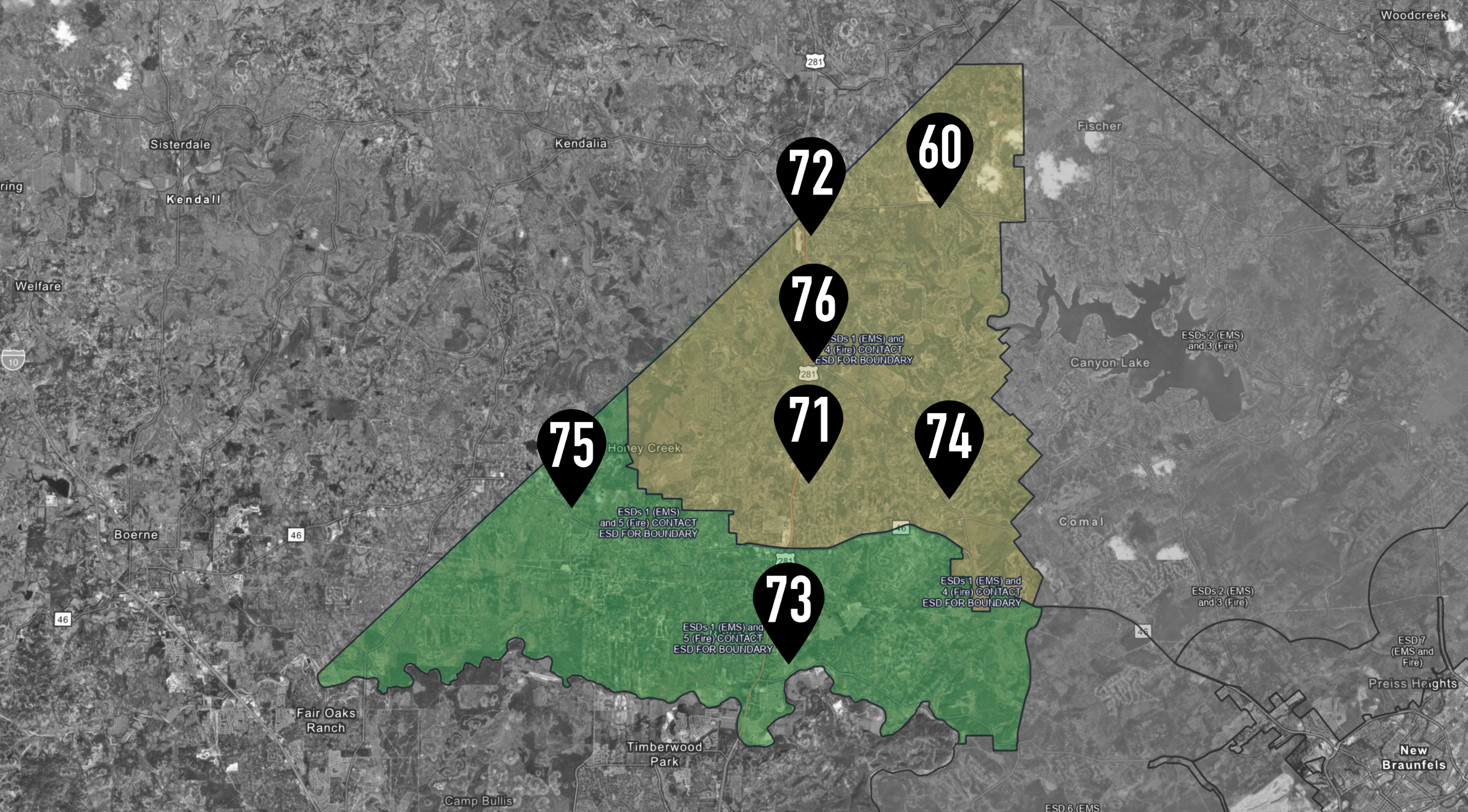
The seven stations listed in the plan.
180 Tanglewood Trail Ct
353 Rodeo Dr.
2016 Peter Creek Rd.
30475 Johnson Way
215 Rebecca Creek Rd.
27534 SH-46
9850 FM-311
Bulverde Spring Branch Emergency Services provides fire and EMS protection to a 216-square-mile region experiencing ongoing residential and commercial development in western Comal County. The district includes diverse terrain, expanding residential corridors, major transportation routes, and growing commercial zones. As development expands and population increases along U.S. 281, Highway 46, and surrounding subdivisions, service demand is rising in both volume and complexity.
BSBES operates a multi-station deployment model to provide timely coverage across this geographically large and varied service area. The current stations serve as the operational backbone of daily response, housing firefighters, medics, apparatus, and equipment essential to delivering high-quality emergency services.
Each station supports district-wide operations but differ in call volume, response area risk profile, staffing patterns, and apparatus mix. These variations inform deployment strategies and help guide decisions regarding future station placement, apparatus distribution, and staffing needs.
Regional population growth is reshaping emergency service needs. As housing developments expand outward and traffic increases on regional highways, response times are influenced by travel distances, roadway conditions, call density, and station placement.
Initial planning indicates the need for:
These projections represent planning-level capacity needs and may be refined through detailed response modeling, financial analysis, and ESD coordination prior to any formal commitments.
Planning-level estimates include:
These estimates are planning-level figures only and will be validated, phased, and prioritized through financial modeling and ESD coordination.
“Response performance” is really just how fast help shows up. Rather than averaging everything, BSBES tracks the share of calls that beat a target time (they call it a “fractile standard”). The goal you’ll see in the box below: the first unit on scene within 10 minutes, 90% of the time, for serious calls. The official text is right after it.
First-unit arrival within 10 minutes, 90% of the time for priority incidents.
BSBES measures its emergency response performance using a fractile standard, which reflects the percentage of calls meeting the target time rather than relying on averages. This approach provides a clearer understanding of system reliability and consistency, particularly in a district as geographically large and diverse as western Comal County.
The organization’s current benchmark is:
First-unit arrival within 10 minutes, 90% of the time for priority incidents.
This benchmark reflects the geographic size, roadway constraints, and mixed rural suburban character of the district and serves as a planning standard rather than a regulatory mandate. It also aligns with regional expectations and supports planning for station placement, staffing configurations, and apparatus deployment.
Maintaining response-time performance requires:
Response performance is a central driver of:
A data-informed understanding of response performance ensures that capital, staffing, and operational decisions support the long-term needs of the community.
Future implementation efforts may incorporate detailed response-time analytics, call-density patterns, GIS modeling, and station-specific performance metrics to support deployment decisions and system optimization.
These enhancements will be tied directly into the Strategic Pillars of Operational Readiness, Infrastructure & Capital Planning, and Technology & Data Systems.
This is about how BSBES keeps its people sharp and ready. It covers the training crews do today, the instructors and space that make it possible, how the organization grows its future leaders, how performance is handled, and how all of it ties back to the bigger plan. The official wording follows.
BSBES personnel complete a comprehensive range of training programs designed to ensure proficiency across all core disciplines, including structural firefighting, wildland operations, emergency medical services, technical rescue, hazardous materials response, and incident command.
In recent years, staff have consistently completed extensive documented training across key areas, including fire suppression and emergency operations, EMS continuing education and clinical skills development, officer development and professional certifications, specialized rescue disciplines, and required compliance and medical credentialing.
Beginning in FY2025-2026, BSBES initiated foundational improvements including standardized, ISO-aligned fire training documentation, a DSHS/NREMT-compliant EMS continuing education framework, instructor quality controls, and a formal leadership development pipeline. These initiatives establish the baseline capability that will be sustained and expanded beginning in FY2027.
This sustained investment in training reflects the organization’s commitment to readiness, safety, and continuous improvement.
Training delivery is currently supported through a blended model that includes in-house instructors and subject matter experts, regional training partners, live-fire and hands-on facilities, online and classroom-based instruction, and shift-level drills and multi-agency training exercises.
As staffing levels, stations, and operational complexity increase, training capacity and infrastructure may require phased expansion to sustain compliance, readiness, and consistency. Key considerations include instructor capacity, training props and equipment, scheduling and coordination systems, and the potential need for dedicated training space or targeted facility enhancements.
These needs will be evaluated and prioritized through the annual budget process, implementation planning, and ongoing Board review.
Sustained organizational growth may require a structured and consistent leadership development pathway that prepares personnel for supervisory, managerial, and command roles. Standardized officer development and succession planning will be critical to maintaining operational consistency, culture, and accountability as staffing expands.
Long-range leadership development will emphasize formal leadership preparation, acting officer training and evaluation, mentorship and coaching systems, credentialing aligned with state and national standards, and succession planning for key operational and administrative positions.
Developing strong leaders is essential to sustaining a healthy organizational culture, supporting employee retention, and ensuring consistency across all shifts, stations, and functional areas.
As the organization grows in size and complexity, standardized performance evaluation and professional development systems will be required to ensure accountability, consistency, and leadership readiness across all roles, shifts, and functional areas.
The organization will implement a structured performance management framework that supports employee development, supervisory accountability, and succession planning, while recognizing the distinct performance expectations of operational and support roles. Detailed policy, evaluation tools, and implementation timelines may be addressed through management action following Strategic Plan adoption.
As call types diversify and community risk evolves, future training may need to adapt to support advanced EMS interventions and clinical performance, enhance technical rescue capabilities, strengthen wildland fire preparation and mitigation skills, and incorporate emerging technologies such as drone operations, GIS tools, and telemetry systems. Training may also emphasize interoperability with regional partners, ESDs, and public safety agencies.
In addition, training approaches may need to be scaled with increased staffing, expanded operational responsibilities, and the introduction of new stations and apparatus to ensure consistent readiness across the organization.
Training plays a critical role across multiple Strategic Pillars, including Staffing, Workforce & Leadership Development; Operational Readiness & Response Performance; Technology & Data Systems; and Community Risk Reduction.
Training priorities identified during the planning process will be incorporated into the Strategic Implementation Framework and Implementation Roadmap.
This approach ensures that training priorities are fully integrated into long-range planning while allowing detailed execution decisions to be phased, aligned with organizational capacity, and evaluated through the annual goal setting and budget processes.
“Apparatus” is just the word for the trucks and vehicles BSBES runs. This section covers the fleet, how vehicles and gear get replaced on a set schedule (their “lifecycle”), and how those big costs get spread out over time. The cards sum up the apparatus types named in the plan, and the full text is below them.
The apparatus types the department operates, per the plan. Add photos by replacing the icon area with an <img> and alt text.
Structural firefighting
Aerial apparatus
Emergency medical transport
Wildland mitigation
Water supply
Command coordination
BSBES relies on a diverse fleet of fire and EMS apparatus to provide effective emergency response across a large and rapidly developing district. Apparatus reliability, strategic deployment, and lifecycle management are essential to maintain operational readiness and ensuring personnel can deliver high-quality service in all incident types. As call volume increases and service expectations rise, the organization must maintain a modern, well-equipped fleet supported by a predictable and financially sustainable replacement schedule.
The department operates a combination of engines, aerials, ambulances, brush trucks, tankers, command units, and support vehicles. Each apparatus type fulfills a distinct operational role, from structural firefighting and wildland mitigation to emergency medical transport and command coordination.
The Logistics Division maintains detailed inventories that include:
This information forms the baseline for long-range capital planning. The current fleet reflects a wide range of apparatus ages and service conditions, reinforcing the need for disciplined lifecycle management and phased capital investment over the next decade.
Apparatus represents some of the organization’s most significant capital assets. Engines, ambulances, and specialty units follow predictable replacement cycles based on NFPA standards, manufacturer guidance, operational demands, and environmental conditions.
Typical lifecycle ranges include:
Logistics analysis indicates that multiple engines, ambulances, tenders, brush units, and support vehicles may require major rehabilitation, remounting, or replacement within the first half of the planning horizon. Several specialty and reserve units also approach the limits of practical service life, increasing reliance on timely capital planning to avoid service disruption.
A structured replacement program reduces downtime, improves reliability, and ensures that frontline apparatus remain safe, capable, and mission ready. As the service area grows and call volumes increase, replacement cycles may need to accelerate to keep pace with operational demand.
In addition to apparatus, BSBES relies on a wide array of equipment essential to mission success, including:
Many of these items have mandated or industry-standard replacement intervals. SCBAs and PPE, for example, must cycle out based on NFPA compliance dates to ensure firefighter safety. EMS equipment must remain interoperable with hospital systems and regional partners.
As innovations in fire and EMS technology advance, equipment modernization may become increasingly important for maintaining operational performance and personnel safety.
Fleet readiness is supported by an in-house maintenance team responsible for routine servicing, repair coordination, and equipment testing. As the fleet expands over the next decade, maintenance capacity may need to grow proportionally to sustain readiness and control costs.
Considerations include:
Maintenance infrastructure is a critical component of the long-range capital plan and must be aligned with fleet growth projections.
As the fleet expands, maintenance capacity must be scaled accordingly. This includes technician staffing, shop space, tooling, and procurement efficiency. Without these parallel investments, fleet availability and readiness may be negatively affected despite timely apparatus replacement.
Projected population growth and increased emergency call volume may require:
Operational readiness is influenced not only by apparatus availability, but also by staffing levels, training capacity, and support infrastructure. As new stations are brought online and service areas expand, apparatus deployment, reserve capacity, and maintenance strategies must be coordinated with staffing and facility development to avoid gaps in coverage.
These needs will be prioritized through annual capital planning, budget development, and Board review processes.
Apparatus and equipment planning connects directly to several key strategic priorities:
Apparatus and equipment replacement planning must remain aligned with long-term financial capacity and revenue variability. While lifecycle needs are well-defined, the timing of replacements, rehabilitations, and fleet expansion may be phased to balance operational risk, fiscal sustainability, and competing organizational priorities.
Capital decisions will be evaluated using scenario-based financial analysis to ensure that fleet reliability is maintained without compromising the organization’s ability to fund staffing, facilities, training, and support services.
“Community Risk Reduction” (CRR) is all about stopping emergencies before they start, through safety education, wildfire prep, health outreach, injury prevention, and local partnerships. This section looks at the programs running today and what they’ll need to grow over the next ten years. The full official text follows.
Community risk reduction (CRR) is a core component of BSBES’s mission to safeguard life and property. As the district continues to develop and service demand evolves, the nature of community risk may evolve, requiring a strategic and proactive approach to prevention, education, outreach, and community health initiatives. BSBES will continue strengthening community risk reduction programs to address emerging hazards and improve public safety awareness. Effective CRR programs reduce the frequency and severity of emergencies, improve community resilience, and lessen the operational burden on fire and EMS resources.
BSBES currently provides a range of community programs designed to address emerging risks, support vulnerable populations, and strengthen relationships between the organization and residents.
Current public education efforts include school safety talks, CPR and Stop the Bleed courses, community events, and limited wildfire preparedness education. These programs are delivered primarily through collateral-duty assignments supported by part-time administrative assistance. As community demand increases and outreach expectations grow, program coordination, scheduling, and tracking may require greater structure and dedicated staffing.
Public education is a critical tool for preventing emergencies before they occur. BSBES delivers educational programs to schools, neighborhoods, businesses, and civic groups to promote safety awareness and preparedness. These efforts help reduce risks associated with fire, medical emergencies, traffic incidents, and community hazards.
Key program areas include:
As the population grows, especially in new subdivisions and multi-family housing, demand for public education outreach will continue to increase.
The region’s expanding wildland urban interface presents a growing risk for vegetation fires and rapid fire spread. BSBES supports WUI mitigation through:
A proactive WUI mitigation strategy is essential to protect life, property, and natural resources as development continues into previously undeveloped areas.
Community Wildfire Protection Plan (CWPP) efforts are underway, with initial neighborhood assessments, wildfire risk mapping, and coordination with the Texas A&M Forest Service. Identified high-risk areas include multiple neighborhoods served by Stations 71, 72, 73, 74, 75, and 60, as well as major transportation corridors and access-constrained areas. Completion and ongoing reassessment of the CWPP will be a key priority throughout the planning horizon.
BSBES is positioned to support community health through targeted EMS outreach programs that address high-risk individuals and frequent service users. These initiatives reduce preventable EMS calls, support hospital diversion goals, and improve patient outcomes.
Current and potential program elements include:
BSBES currently supports Mobile Integrated Health (MIH) and Mental Health and Developmental Disabilities (MHDD) initiatives through referral-based outreach and regional partnerships. As service demand and community health complexity increase, these programs will require formalized missions, policies, training standards, and dedicated staffing to ensure consistent delivery and integration with EMS operations.
BSBES supports community safety through targeted injury prevention efforts, including:
These programs are essential to reducing preventable emergency incidents and lowering risk in both residential and commercial settings.
Injury prevention efforts are currently limited by inconsistent messaging, lack of formal program ownership, and insufficient data collection. Future program development should focus on defining clear objectives, standard operating guidelines, and reliable data tracking to support evidence-based outreach and measurable outcomes.
Strong relationships with community groups, schools, businesses, and civic organizations enhance the reach and impact of BSBES programs. As the district continues to grow, expanding partnerships will be critical to maintain visibility, trust, and effective engagement.
Current and emerging partnerships include local school districts, chambers of commerce, wildfire and forestry agencies, healthcare providers, utilities, and regional government entities. Expanding and formalizing these relationships will be essential to scaling CRR efforts and maximizing community impact.
These partnerships support coordinated prevention strategies and provide opportunities for joint training, events, and outreach.
Community engagement strategies may include station-based outreach such as open houses, educational tours, and neighborhood events to strengthen visibility, trust, and public understanding of BSBES services.
Future Community Risk Reduction needs will likely require formal recognition of CRR as a core organizational function. This includes establishing dedicated leadership, administrative support, defined intake processes, consistent data tracking through ESO Suite, and a sustainable operating budget. Long-term success will depend on transitioning CRR activities from collateral duties to structured programs aligned with community risk profiles and service demand.
Community Programs & CRR directly support several Strategic Pillars:
These programs reduce operational demand, improve outcomes, and help ensure BSBES remains proactive in protecting the residents it serves.
The analysis of the service area, stations, response performance, training programs, fleet resources, and community risk reduction initiatives reveals several clear themes that will shape BSBES’s priorities from 2027 through 2037. Together, these operational realities highlight the need for sustained investment, coordinated planning, and a long-term strategy that aligns staffing, infrastructure, equipment, and community engagement with the demands of a rapidly growing region.
Key implications for the next decade include:
The operational realities outlined in Sections 2 through 7 make clear the scale and complexity of the challenges BSBES will face over the next decade. Population growth, evolving community risks, expanding service demand, and increasing operational requirements all point to the need for a structured, forward-looking framework to guide decision-making.
Section 8 introduces Strategic Pillars, six long-term priorities that provide the foundation for aligning investments, staffing, operations, and partnerships throughout the 2027-2037 planning horizon.
These six priorities steer the entire plan. Open any pillar below to see its official Purpose, 10-Year Objectives, and Why This Matters. Collapse them to skim, or expand them all to read straight through. Want the quick version first? The pillar cards near the top of the site cover it.
The Strategic Pillars represent the core priorities that will guide BSBES over the next decade. These pillars were developed from operational analysis, community risk trends, departmental input, and the long-range planning context. Together, they provide a durable framework for aligning resources, staffing, capital investments, and service delivery with the evolving needs of the community.
To ensure that BSBES has the facilities, apparatus, and equipment necessary to meet current and future service demands. This pillar guides long-term investment in stations, fleet, technology, and specialized resources that support a resilient and modern emergency services system. This includes not only frontline response assets, but also the facilities, maintenance infrastructure, and support services required to sustain daily operations.
Infrastructure investment is foundational to maintaining reliable response performance in a rapidly growing region. Without timely expansion of facilities and apparatus, BSBES will likely face widening service gaps, increased strain on personnel, and diminished ability to meet community expectations. Capital planning that focuses solely on stations and apparatus, without equivalent investment in support infrastructure, increases long-term risk and inefficiency. Balanced investment across frontline and support systems ensures that growth is sustainable, fiscally responsible, and operationally effective.
To build and maintain a highly skilled, adequately staffed, and future-ready workforce capable of delivering exceptional fire and EMS services. Responder health, safety, and wellness are essential to sustaining service delivery, workforce retention, and operational continuity over the long term. This pillar ensures that recruitment, retention, training, and leadership development keep pace with rapid organizational and community growth.
Leadership development within BSBES extends beyond line supervision and includes chief officers and executive administrative staff. As the organization grows in size and complexity, consistent leadership expectations, professional development, and executive readiness are critical to organizational performance, accountability, and continuity. Leadership expectations and development standards will be applied consistently across operational, administrative, and executive roles. Professional development may also include structured orientation and education opportunities for ESD Commissioners to support informed governance, policy oversight, and alignment with operational realities.
As staffing levels increase and operations expand, investment in human resources systems and administrative capacity may be required to ensure consistent hiring, onboarding, credential tracking, and compliance. Scalable HR processes support operational readiness by reducing variability, improving accountability, and enabling supervisors to focus on mission-critical activities.
A strong workforce is the backbone of emergency services. As the district grows, staffing and leadership development must expand proactively to ensure operational readiness, organizational health, and continuity of service.
To maintain and improve BSBES’s ability to respond efficiently and effectively to all emergencies. This pillar focuses on deployment models, training, equipment, and operational practices that ensure consistent, high-quality service delivery. Operational readiness is increasingly dependent on regional coordination, interoperability, and system-level integration across fire, EMS, and emergency management partners.
Response performance is the most visible indicator of emergency service effectiveness. Ensuring operational readiness protects life and property, builds community trust, and validates the investments made by supporting ESDs.
To reduce preventable emergencies through targeted education, mitigation, outreach, and community health initiatives. This pillar supports proactive strategies that address evolving risks associated with growth, Wildland Urban Interface (WUI) expansion, and vulnerable populations.
Reducing community risk lowers call volume, improves safety outcomes, and supports better health and resilience across the district. Proactive prevention efforts complement emergency response and reduce long-term operational strain.
To ensure BSBES has the digital tools and technology infrastructure needed to operate efficiently and make informed decisions. This pillar modernizes communication, reporting, analytics, and interoperability systems across the organization.
Technology drives operational efficiency, reliability, and safety. Modern, integrated systems enable BSBES to manage resources effectively, improve performance, and maintain interoperability with regional partners.
To strengthen coordination with participating ESDs, local governments, public safety agencies, and regional partners in support of Board-directed priorities and regional service delivery. This pillar ensures consistent planning, shared resources, and unified response to emergencies across jurisdictional boundaries.
Effective interagency coordination enhances response capability, improves resource efficiency, and strengthens regional resilience. Partnerships ensure that BSBES can meet the needs of a growing population without duplicating effort or creating service gaps.
The Strategic Pillars establish a long-term direction for the organization, but effective implementation requires a clear understanding of the resources, needs, and constraints within each department. To support this alignment, every division contributed detailed operational data, forecasts, and planning inputs that inform the development of actionable goals and initiatives.
Section 9 summarizes these departmental submissions and forms the foundation for refining the priorities and sequencing identified in the Strategic Pillars.
Every BSBES division had a hand in this plan: Operations, Training, Human Resources, Logistics, the Comptroller, and Community Risk Reduction. Each one turned in detailed information about its needs. This section sums up what they shared and how it fed into the six Strategic Pillars. The official text follows.
To ensure the 2027–2037 Strategic Plan is grounded in accurate operational data, financial capacity, workforce trends, and long-term capital requirements, each department was directed to complete a standardized planning template tailored to its functional responsibilities. These submissions create a comprehensive organizational baseline and ensure every division contributes meaningfully to the development of strategic goals, measurable objectives, and long-range initiatives.
The summaries in this section reflect departmental input reviewed and incorporated through the Strategic Plan Working Group process. These submissions informed the development of Strategic Pillars, implementation priorities, and long-range planning assumptions.
Each department’s submission includes factual baselines, trend analysis, staffing needs, operational challenges, capital requirements, and 10-year considerations that directly inform the organization’s planning horizon. Section 9 summarizes strategic needs and operational trends identified by each division; detailed implementation plans, staffing models, organizational structures, and performance metrics will be developed during the implementation framework phase and incorporated into future operational planning and budget processes.
The Operations Division submitted a comprehensive overview of current staffing levels, daily staffing configurations, apparatus assignments, station profiles, and response area characteristics for each BSBES fire and EMS station. The division also provided three-year call volume trends and identified key operational strengths and limitations.
Key Components Include:
This information establishes the baseline for evaluating deployment models, supervising growth-driven staffing requirements, planning additional stations, and maintaining operational readiness over the next decade.
Maintaining a first-unit response time goal of 10 minutes or less for 90% of priority incidents will remain a primary system performance objective guiding deployment planning, staffing considerations, and future system design.
The Training Division submitted a comprehensive strategic planning package and narrative analysis addressing workforce training requirements, leadership development and officer progression, certification and credentialing pathways, annual training delivery models, instructional capacity, facilities and infrastructure needs, and long-range program development.
The submission outlines a phased approach to sustaining ISO-aligned fire training and DSHS/NREMT-compliant EMS education, professionalizing the instructor cadre, formalizing leadership development and succession planning, and expanding training capacity through facilities, technology, and regional partnerships.
This input informs workforce planning, leadership development strategies, and capital planning considerations and will be integrated through the Strategic Implementation Framework and Implementation Roadmap rather than inserted wholesale into the Strategic Plan body.
The Training Division will continue to support organizational compliance with state licensing and regulatory requirements, including EMS and fire certification standards.
Human Resources provided a detailed workforce profile and identified long-range staffing and organizational needs that must be monitored throughout the 2027-2037 planning horizon.
Key Components Include:
This dataset will directly inform future staffing models, compensation strategies, retention initiatives, and administrative support requirements.
Human Resources will play a critical role in supporting organizational growth by ensuring compliance, consistency, and workforce sustainability. As staffing expands, HR systems and processes will evolve to support increased hiring activity, credential management, injury reporting, and employee development.
Human Resources policies and compensation structures will continue to be evaluated and updated during Phase I to support workforce stability and organizational growth.
The Logistics Division submitted a complete inventory of apparatus, equipment, Personal Protective Equipment, Self-Contained Breathing Apparatus, communications systems, and facilities. This constitutes the foundation of BSBES’s long-range capital and lifecycle replacement planning.
Key Components Include:
This submission forms the backbone of the 10-year capital forecast and supports prioritization of lifecycle replacement and infrastructure investment.
The Comptroller’s Office provided the financial baseline required to assess BSBES’s long-term fiscal capacity and constraints.
Key Components Include:
This financial baseline ensures the strategic plan is grounded in fiscal reality and guides decisions related to capital phasing, staffing expansion, and funding strategy development.
The Community Risk Reduction (CRR) Division submitted a detailed overview of current programs, staffing limitations, wildfire preparedness efforts, injury prevention initiatives, community health outreach, and long-term resource needs. The submission identifies significant reliance on collateral-duty personnel, limited dedicated funding, inconsistent data tracking, and growing demand for services across public education, WUI mitigation, and community health.
Key components include:
This input will inform CRR staffing models, budget development, risk mapping, and integration into the Strategic Pillar of Community Risk Reduction & Public Safety Engagement.
Deployment and system design will continue to be informed by ongoing Community Risk Assessment to address current and emerging hazards.
Administrative leadership and the Strategic Plan Working Group:
This structured integration process ensures that the 2027-2037 Strategic Plan is department-informed, financially grounded, operationally realistic, and strategically aligned with long-term community needs.
The departmental inputs outlined in Section 9 provide the operational and organizational detail needed to translate the Strategic Pillars into actionable steps. Together, these submissions create a comprehensive picture of the staffing, facilities, fleet, training, technology, financial considerations, and community programs required to support service delivery over the next decade.
Section 10 presents the Implementation Roadmap, an organized framework for phasing initiatives, allocating resources, and monitoring progress across the 2027-2037 planning period.
This is the “how and when.” The plan plays out in three phases over ten years, with a check against the budget every year. Phase I steadies things, Phase II expands, and Phase III fine-tunes. For the quick version, the Implementation Timeline near the top lays it out visually. The official text follows.
The Implementation Roadmap translates the Strategic Pillars into a phased, actionable framework that guides BSBES through the 2027-2037 planning horizon. It provides the structure for sequencing major initiatives, allocating resources, monitoring progress, and aligning annual budgets with long-range priorities.
This Strategic Plan establishes direction and priorities. Detailed performance metrics, financial modeling, deployment analysis, and operational efficiency studies will be developed during subsequent implementation and budget phases. The Roadmap is intentionally designed to support disciplined decision-making while allowing flexibility to adjust timing, scope, and sequencing based on financial capacity, operational realities, and Board direction.
Phase I initiatives represent operational requirements necessary to maintain service reliability and support projected growth. Phase II and Phase III initiatives represent future capacity expansion and long-term system optimization efforts, to be pursued as conditions, resources, and Board priorities allow.
Implementation of this roadmap will be reviewed annually through the budget development process. Financial performance, revenue trends, cost escalation, and reserve levels will be evaluated to determine whether planned initiatives should proceed, be deferred, or be re-sequenced to maintain fiscal responsibility.
Training initiatives will prioritize compliance with applicable regulatory and operational standards, with any expansion beyond baseline requirements subject to evaluation of operational benefit, cost-effectiveness, and Board-approved funding.
Integrated Implementation: Operational staffing, facilities, fleet, training, and support services will be implemented in a coordinated manner. No single element will advance independently without consideration of its impact on overall system readiness and financial sustainability.
During the implementation phase, each initiative will be assigned to a responsible division or position, with clear accountability aligned to job descriptions, performance expectations, and annual evaluation processes to ensure execution.
While major capital expansion of training facilities is planned for Phase II (2030–2033), foundational actions to support training capacity will begin during Phase I (2027–2029). These early actions include instructor staffing, curriculum development, scheduling optimization, and evaluation of facility and infrastructure needs.
Training capacity is recognized as a critical enabling function that supports workforce growth, operational readiness, and organizational standardization. Phase II reflects the larger-scale facility or infrastructure expansion necessary to support long-term organizational growth, while Phase I focuses on stabilizing and preparing the Training Division to support increased hiring and operational demands.
The Phase II timeframe represents the baseline planning horizon based on current growth projections and financial assumptions. Should operational need, funding availability, partnership opportunities, or other strategic conditions support earlier implementation, the Board may consider advancing training facility development into Phase I following appropriate financial and operational analysis.
Following the receipt and analysis of departmental submissions, the Implementation Roadmap will be expanded to include:
The Implementation Roadmap establishes the pathway for achieving the objectives of the 2027-2037 Strategic Plan. It links long-range priorities to annual decision-making and provides the structure necessary for disciplined execution, accountability, and continuous organizational improvement. Appendices included in this plan provide the technical foundation - data, inventories, and projections - required to evaluate progress, adjust assumptions, and guide future budget development.
This Strategic Plan will be reviewed and updated at least every three years to reflect changes in service demand, financial conditions, and organizational priorities. Phase II and Phase III initiatives represent long-range planning assumptions and will be refined through periodic updates.
The plan lists these appendices as supporting documents that come later. They’re shown below exactly as the plan lists them, with nothing added or made up.
The 2027-2037 Strategic Plan establishes a clear and actionable vision for the future of Bulverde Spring Branch Emergency Services. By analyzing current capabilities, anticipating long-term community needs, and identifying strategic priorities, the plan provides a roadmap for delivering high-quality fire, EMS, and prevention services to a rapidly growing region.
Implementation of this plan will require collaboration across all levels of the organization, strong partnerships with supporting Emergency Services Districts, and disciplined alignment between operational needs and fiscal capacity. As conditions evolve, BSBES will review and update this plan regularly, ensuring that strategies remain relevant, data-driven, and responsive to community expectations.
Through continued commitment to excellence, innovation, and service, BSBES will remain a resilient, adaptable, and forward-looking organization - prepared to meet the challenges of today and the opportunities of tomorrow.